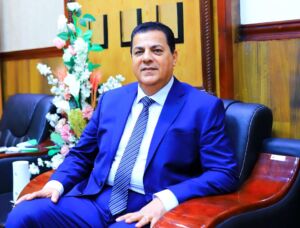
University PresidentEditor2026-03-30T11:58:20+02:00
“Professor Dr. Jean Henry Hanna”
President of Beni Suef Technological University
Dr. Mohamed Ayman Ashour, Minister of Higher Education and Scientific Research, has approved the appointment of Professor.Dr. Jean Henry Tomas to serve as Acting President of Beni-Suef Technological University.
Dr. Tomas obtained his Ph.D. in Automatic Control Engineering from University of Paris, France, in 2004. He previously earned a Master’s degree in Process Control from Eindhoven University of Technology in the Netherlands in 1997, in addition to a Postgraduate Diploma in Education from the same university. He received his Bachelor’s degree in Electrical Power Engineering from the Faculty of Engineering at Minia University in 1991.
Prior to assuming the presidency of the university, Dr. Tomas held several academic and administrative positions. Most recently, he served as Acting Vice President for Education and Student Affairs at Beni-Suef Technological University. He also served as Head of the Electrical Engineering Department and later Vice Dean of the Faculty of Engineering at Beni-Suef University. Additionally, he worked as Director of the Integrated Technological Education Project in Abu Ghaleb, affiliated with the Education Development Fund. He also served as a consultant to the Planning Committee at Beni-Suef University, Director of the Center for the Development of Talented, Creative, and Innovative Students at the same university, and Strategic Planning Expert at the Strategic Planning Unit of the Ministry of Higher Education and Scientific Research.
Professor Dr. Tomas has contributed significantly to the graduation of the first cohort of Beni Suef Technological University and to the establishment of the University’s Graduate Follow-up Unit. He has also concluded multiple cooperation protocols with major industrial corporations to provide student training and facilitate employment opportunities for graduates. Furthermore, he played a key role in establishing an integrated technological educational complex in Abu Ghalib, Giza, encompassing a technical secondary school and a technological college granting a Bachelor of Technology degree. The project, funded jointly by the Egyptian and Italian governments, was developed and implemented in accordance with the latest educational systems, incorporating a distinguished competency-based approach drawing upon Italian expertise. The initiative aims to advance technical and technological education in Egypt, better align it with labor market needs, and enhance the competitiveness of Egyptian technicians and technologists.
In addition, Professor Dr. Tomas served as the National Coordinator for the project reviewing the technical higher education system in Egypt in cooperation with the Organisation for Economic Co-operation and Development (OECD). This project aimed to modernize the system to better respond to labor market demands, culminating in the preparation of a national report, participation in drafting recommendations, and engagement in international comparative analysis across 22 countries.
Furthermore, Dr. Tomas participated in several meetings of the National Experts Committee on Technical Education affiliated with the Organisation for Economic Co-operation and Development in Paris. He also contributed to the preparation of the Strategic Plan for Higher Education in Egypt in 2014, and participated in the preparation of an analytical study on the engineering education sector in Egypt. In addition, he took part in numerous international workshops, seminars, and official meetings in the field of technological and technical education, addressing key themes including quality assurance in education, alignment of education with labor market requirements, enhancement of students’ skills, and competency-based curricula.
Dr. Tomas also participated in the Technical Institutes and Community Colleges Administrative Leadership Program in the United States, during which he visited several community colleges in the United States in 2022 to gain insight into the community college education system and its management. He also took part in the “Policy Makers Training Program” in South Korea in 2015, which aimed to familiarize policymakers with the technical and technological education system in South Korea and its developmental progress.
Dr. Tomas has also made several scientific and research contributions. These include a project on the design of a predictive control program for controlling a PMSG generator operating on a wind turbine, funded through the Science and Technology Development Fund (STDF) at the Academy of Scientific Research and Technology. He also contributed to the design of the main control program for the Idbäcken power plant in Nyköping, implemented for the Swedish energy company Vattenfall.
Additionally, he served as the Principal Investigator of the Egyptian research team in an Egyptian–French collaborative research project implemented through the Imhotep Program at the Academy of Scientific Research and Technology. The project aimed to design a reliable control system for hybrid systems that may be subjected to disturbances or parameter variations.
He also contributed to the design of algorithms for predicting different operational conditions, detecting faults, and controlling water levels in steam-based power generation systems, in cooperation with Électricité de France.
Dr. Tomas scholarly and research contributions include projects such as the design of a predictive control programme for a PMSG wind turbine generator under the STDF programmes of the Academy of Scientific Research and Technology in Egypt; the design of a master control programme for the “Edipkun” power plant in Nässjö, Vattenfall Company, Sweden; serving as Principal Investigator for the Egyptian research team in a Franco‑Egyptian collaborative project supported by the Imhotep Programme of the Academy of Scientific Research and Technology, aimed at developing a robust control system for hybrid systems subject to disturbances or parameter variations; and contributing to the development of algorithms for state estimation, fault detection, and water level control within a steam power generation system operated by Électricité de France(EDF).